Best Car Insurance: 7 Companies to Compare in 2026


Choose car insurance by comparing the coverage you need, the full policy price and the deductible you could afford after an accident. A low premium is useful only when the policy protects what matters.
Compare these seven insurers on price, coverage and claims service. Use the same limits and deductibles for every quote to see which offers the strongest value. The profiles below highlight each company’s useful features and the terms that matter when you buy.
For New York drivers, include no-fault benefits and uninsured-motorist protection in the comparison. Check the separate liability limits for injuries and deaths, then decide whether the state minimums provide enough protection for your finances.
Compare Car Insurance Rates
Get quotes with your chosen coverage limits and deductible. PropertyNest may earn compensation from the partner links below.


Compare Liberty Mutual for replacement-car benefits, Allstate for rideshare coverage, State Farm for agent-guided bundles, Progressive for discounts and driving-based pricing, GEICO for digital management, Nationwide for accident forgiveness, and Farmers for repair and transportation options.
Liberty Mutual: Replacement-Coverage Options

Put Liberty Mutual on your shortlist if replacing a totaled car with a newer vehicle is a priority. Its optional Better Car Replacement benefit bases the replacement on a car one model year newer with 15,000 fewer miles. Leased cars and motorcycles are excluded.
Request a quote with and without the add-on to see its cost. Confirm the applicable deductible and vehicle eligibility. If your loan balance exceeds the car’s value, compare gap coverage separately: it addresses the loan shortfall rather than the age and mileage of the replacement.
Read our Liberty Mutual car insurance review for more detail.
| Measure | Totaled car | Replacement basis |
|---|---|---|
| Model year | 2021 | 2022 |
| Mileage | 60,000 miles | 45,000 miles |
Hypothetical example applying Liberty Mutual’s published benefit; no dollar quote implied. Eligible covered total loss, subject to deductible and policy terms. As of September 2026.
Allstate: Coverage for Rideshare Gaps

Consider Allstate if you drive for a rideshare platform and need help covering gaps between your personal policy and the platform’s insurance. Ride for Hire addresses coverage during different stages of a trip and can help with a deductible gap.
Allstate illustrates the benefit with a $500 personal collision deductible and a $2,500 platform deductible: an eligible endorsement may cover the $2,000 difference. Have the agent confirm the benefit, eligible platform and coverage in each trip phase for your state.
In New York City, start with the TLC’s vehicle insurance requirements. TLC-licensed vehicles need the required commercial coverage; a personal-policy rideshare endorsement alone does not establish compliance. Tell the agent about delivery work as well as passenger trips.
State Farm: Home and Auto Comparison

Start with a State Farm agent if you want help coordinating car insurance with a home, condo or renters policy. Its multi-policy discounts reward eligible combinations, and an agent can review the household’s drivers, vehicles and coverage together.
Ask for the combined annual cost and compare it with separate policies offering the same protection. That total tells you more than the advertised discount percentage.
Also ask about Drive Safe & Save if you are comfortable sharing driving data. State Farm advertises savings up to 30%; its New York discount is capped at 30%. Eligibility, available discounts and actual savings depend on the state and policy.
Progressive: Discounts and Usage-Based Pricing

Include Progressive when you want several ways to tailor the price. Its discount options include eligible policy bundles, multiple cars, students and payment choices. Set your coverage limits before using its budget tool so the resulting quote keeps the protection you need.
Snapshot uses driving data to personalize the price, generally at renewal after enough data has been collected. This can reward lower-risk driving, while higher-risk behavior can increase the rate where the program allows it. Review the data permissions before enrolling.
New York detail: the initial participation discount is unavailable in New York. Evaluate the driving-based renewal terms separately from signup promotions.
See our Progressive car insurance review.
GEICO: Digital Policy Management
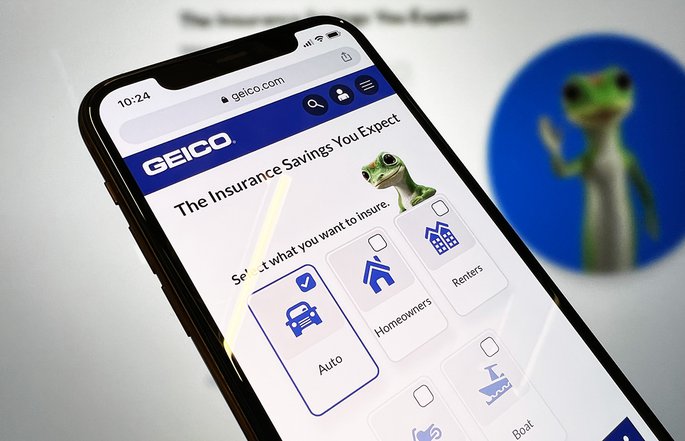

Consider GEICO if you prefer handling routine insurance tasks online. Its digital tools provide access to policy information, ID cards and claims reporting and tracking. Compare a quote with your chosen limits and deductibles to judge its price alongside that convenience.
Ask whether you qualify for Claim Forgiveness. Where available, the benefit can be earned or purchased and waives the surcharge for the first qualifying loss caused by an eligible driver. It applies once per policy, shared by the eligible drivers on it.
Read our GEICO car insurance review.
Nationwide: Optional Accident Forgiveness

Consider Nationwide if avoiding an accident-related surcharge is a priority. Its optional Accident Forgiveness can protect against a rate increase after a first at-fault accident. It is available in select states and can be used once per policy, including by another eligible driver on the policy.
Request the price with and without the endorsement and confirm which accidents qualify. The benefit addresses the accident surcharge; unrelated changes in the insurer’s rates can still affect your renewal premium. Choose it based on that specific protection and its added cost.
Farmers: Replacement Parts and Transportation Benefits


Compare Farmers when the details of a repair matter to you. Its optional coverages include original manufacturer parts for eligible cars up to 10 years old and rental reimbursement for up to 30 days while a car is being repaired. Coverage limits and availability vary by state and policy.
Drivers who would rather use transit or rideshare services can ask about its rental-alternative benefit, which pays a daily stipend up to the selected limit. Obtain the price and daily limit for each option before adding it.
Farmers also offers vehicle-replacement features in some states. Ask the agent to confirm the vehicle-age and mileage requirements for your quote. Keep collision and comprehensive separate in the comparison: they insure different causes of vehicle damage, and a lender may require both.
| Insurer / option | Published benefit | Key condition |
|---|---|---|
| Liberty Mutual / Better Car Replacement | Replacement basis: one model year newer and 15,000 fewer miles | Optional; leased cars and motorcycles excluded |
| Allstate / Ride for Hire | Can bridge a personal-policy and rideshare-platform deductible gap | State and platform eligibility; separate TLC requirements in NYC |
| State Farm / Drive Safe & Save | Driving-based discount up to 30%; NY cap 30% | Requires setup and driving data; actual discount varies |
| Progressive / Snapshot | Driving-based renewal pricing | No NY signup discount; increases possible where permitted |
| GEICO / Claim Forgiveness | Waives surcharge for first qualifying loss | One use per policy; eligible drivers share the benefit |
| Nationwide / Accident Forgiveness | Protection against first at-fault accident surcharge | Optional paid benefit; once per policy in select states |
| Farmers / repair and transportation options | OEM parts for cars up to 10 years old; rental reimbursement up to 30 days | Optional; state eligibility and selected limits apply |
PropertyNest comparison of official Liberty Mutual, Allstate, State Farm, Progressive, GEICO, Nationwide and Farmers product terms. Features serve different purposes; discounts are not additive. As of September 2026.
What Does Car Insurance Cover?
Car insurance combines separate coverages. Liability addresses injury or property damage you cause to others. Collision and comprehensive concern damage to the insured vehicle. Medical payments or personal injury protection address eligible injury expenses; they are not simply another name for liability.
“Full coverage” is shopping shorthand, not a contract guaranteeing every loss. It commonly means the required coverages plus collision and comprehensive, but you must specify the limits, deductibles and additions.
Collision and Comprehensive
Collision generally addresses a crash with a vehicle or object, or an overturn. Comprehensive generally addresses theft, fire, hail, flood, vandalism or contact with an animal. Each has its own terms and usually a selected deductible. A lender or lessor may require both.
Source: NAIC coverage guidance.
New York Requirements
The table below summarizes minimum coverages for most private passenger vehicles. New York DFS explains that basic no-fault pays eligible injury-related economic losses up to $50,000 per person; it does not repair your car. Supplementary uninsured/underinsured motorist coverage deserves a separate discussion from the mandatory minimum uninsured-motorist protection.
Keep New York-issued liability coverage active while the registration remains valid, even when a car is not being driven. Confirm proper cancellation and plate procedures before ending a policy. See DMV requirements.
| Coverage | Minimum for most private passenger vehicles | |
|---|---|---|
| Bodily injury liability | $25,000 per person / $50,000 per crash | |
| Death liability | $50,000 for one person / $100,000 for two or more | |
| Property damage liability | $10,000 per crash | |
| Basic no-fault (PIP) | $50,000 per person | |
| Uninsured-motorist bodily injury | $25,000 per person / $50,000 per crash |
Sources: New York DMV and DFS coverage checklist. As of September 2026. These are legal minimums. Commercial, for-hire and other vehicle classes have different requirements.
What Is Not Automatically Covered?
A personal auto policy generally does not pay for maintenance, ordinary wear or an unrelated mechanical breakdown. Rental reimbursement, roadside service, gap protection and business or rideshare use need their own review.
A stolen laptop is a different loss from a stolen car. Coverage for personal belongings may come from a renters or homeowners policy, subject to limits and a deductible. Do not assume an auto comprehensive limit protects everything left on the seat.
Source: NAIC auto insurance consumer guide. Ask about your actual use of the vehicle, including delivery work, frequent drivers and custom equipment.
How Much Does Car Insurance Cost?
New York’s average annual auto insurance expenditure was $1,752.55 in 2023, compared with $1,281.92 nationwide, according to the NAIC. The table shows how that historical benchmark changed over time. It combines vehicles with different coverage purchases, so use current quotes to price the protection you need today.
Your price depends on your vehicle, drivers, location, use and selected coverage. Request the same limits and deductibles from each insurer, and compare matching policy periods. See our full-coverage shopping guide for help building that comparison.
| Observation year | U.S. annual average | New York annual average |
|---|---|---|
| 2019 | $1,075.08 | $1,446.14 |
| 2022 | $1,124.57 | $1,548.26 |
| 2023 | $1,281.92 | $1,752.55 |
Source: NAIC 2022/2023 Auto Insurance Database Report, Table 4. Historical 2019–2023 data; as of September 2026. Average expenditure divides liability, collision and comprehensive written premiums by liability written exposures. Coverage purchases differ; this is a historical benchmark, not a standardized coverage quote.
How to Save Without Creating a Coverage Gap
Compare renewal offers, confirm applicable discounts and keep mileage and vehicle-use information accurate. Ask for the cost of each optional coverage so you can see what is driving the total.
New York's approved Point and Insurance Reduction Program provides an insurance reduction for three years. The qualifying reduction applies to the base rate of liability, no-fault and collision premiums; it is not a blanket 10% cut to every charge on the bill. Verify the approved course and submit the completion documentation required by your insurer.
Before dropping collision on an older car, compare the annual premium with the vehicle's value after the deductible, and ask whether you could replace it from savings. A car can be inexpensive on paper and indispensable for getting to work.
Put the Deductible in Dollars
In this hypothetical example, a $3,000 covered repair would produce a $2,500 payment with a $500 deductible or $2,000 with a $1,000 deductible. The higher deductible adds $500 of risk on that claim. If it saves $100 a year, five years of savings equals that difference.
Usage-based insurance also has trade-offs. Ask what driving data is collected, whether a surcharge is possible and when the rate changes. Safe driving remains worthwhile even when broader repair costs or rate changes push premiums up.
Compare Car Insurance in Your State
Find the Best Car Insurance in Your State
PropertyNest Data and Editorial Method
PropertyNest compares insurer features using official product descriptions, with coverage guidance from the NAIC and New York DMV, DFS and TLC. As of September 2026. The profiles compare products; they do not measure insurer prices or claims-service performance.
The cost table uses Table 4 of the NAIC 2022/2023 Auto Insurance Database Report. Figures retain their observation years and reflect differing coverage purchases. Hypothetical examples are labeled. For your own price comparison, request identical coverage and policy periods from each insurer.
Partner quote placements are advertisements. PropertyNest may earn compensation when you use these links; advertised savings depend on the offer’s eligibility and terms.
- Selection Criteria: Companies are chosen based on customer service, affordability, and coverage diversity.
- Data Collection: Data is amassed from credible sources, customer surveys, and industry reports.
- Analysis: A robust analysis, employing a scoring system, is conducted to rank the companies.
- Updating: This page is regularly updated to offer the most current information.
- Editorial Integrity: We uphold a transparent editorial process and disclose any affiliations.
- User Engagement: User feedback is integral and factored into our evaluations.
- Accessibility and Usability: Our page is crafted for ease of use, mobile optimization, and wide accessibility.
- Editorial Independence: Our editors and writers work independently, free from influence by advertisers.
- Source Disclosure: All data sources are disclosed and credited.
- Conflict of Interest: Any potential conflict of interest is disclosed to maintain integrity.
- Reviewer Qualifications: The qualifications of reviewers and contributors are provided.
- Update Frequency: The frequency of updates and revisions is clearly stated.
- Correction Policy: A clear policy for correcting errors is in place to uphold accuracy and trust.